May 26, 2026
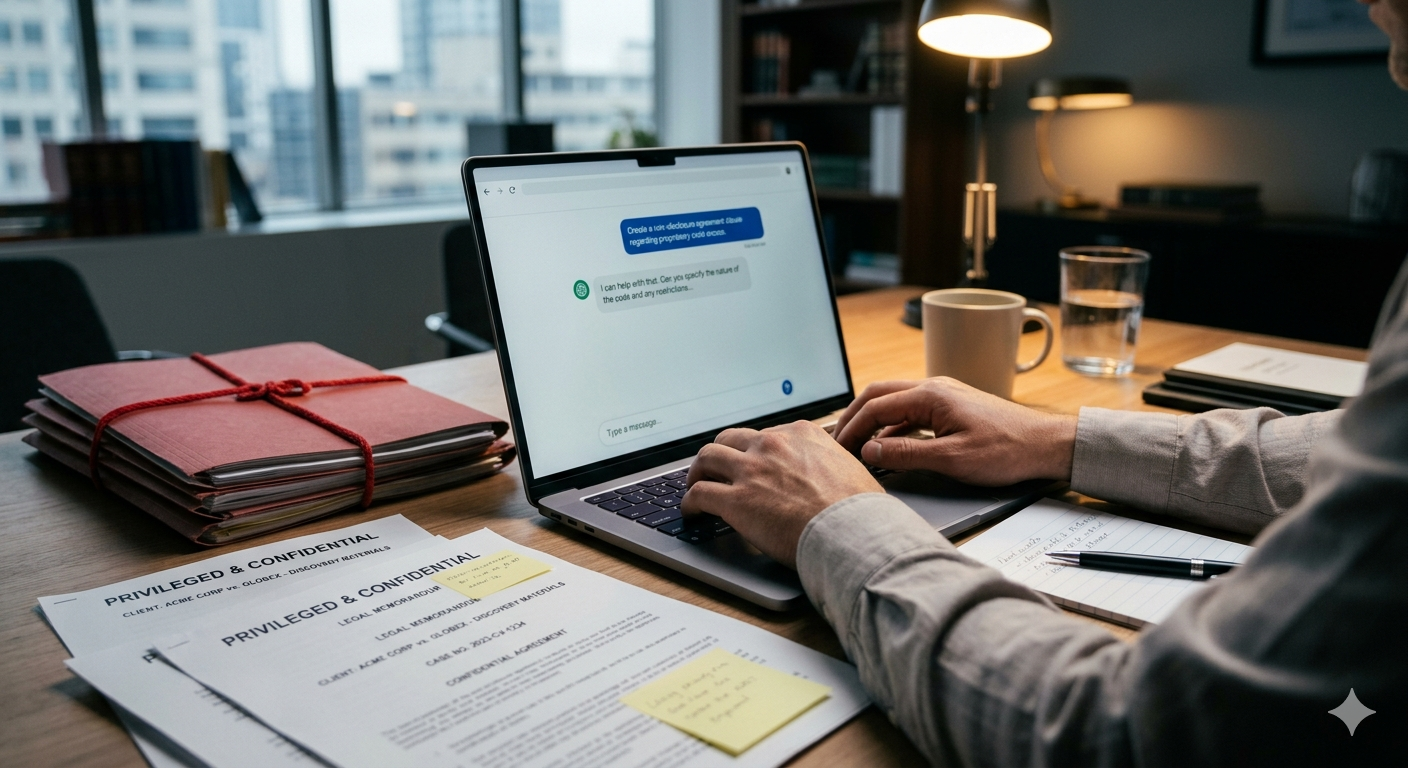
You hire a lawyer because you need someone you can talk to honestly. The law protects that honesty through two of the most important shields in our legal system: the attorney-client privilege and the work product doctrine. They let you tell your attorney the full story without that conversation becoming evidence against you later.
But a recent federal court ruling is making something uncomfortably clear: those shields can disappear the moment you paste your situation into ChatGPT, Claude, Gemini, or any other public AI tool.
If you are currently engaged in a legal matter—a lawsuit, an estate plan with sensitive family dynamics, a real estate dispute, an employment claim, a tax issue—this is something you should understand before you open another AI chat window.
The attorney-client privilege protects confidential communications between you and your lawyer made for the purpose of obtaining legal advice. It is one of the oldest and most jealously guarded protections in American law, and it exists for a simple reason: if clients cannot speak candidly with their lawyers, lawyers cannot give them sound advice.
The work product doctrine is a related but separate protection. It shields materials prepared by your attorney—or at your attorney’s direction—in anticipation of litigation. Strategy memos, drafts, mental impressions, theories about the other side’s case. These are kept out of the hands of opposing parties so that lawyers can think and plan freely.
Both protections share a common vulnerability: they can be waived. And once waived, they are extremely difficult to claw back.
In United States v. Heppner, Judge Jed S. Rakoff of the Southern District of New York issued what the Harvard Law Review called a “question of first impression nationwide”—the first federal ruling to squarely address whether a client’s conversations with a public AI chatbot can be protected by attorney-client privilege or the work product doctrine. (Harvard Law Review)
The answer, on the facts before the court, was no.
The defendant had been indicted on federal securities and wire fraud charges. Before his arrest, he had used a consumer generative AI platform to research legal issues connected to his case, generating dozens of documents that he later shared with his attorneys. After the FBI seized those documents, the government moved for a ruling that they were not privileged. At a pretrial conference, Judge Rakoff said from the bench, “I’m not seeing remotely any basis for any claim of attorney-client privilege,” noting that the AI tool’s terms provided that information inputted was not confidential and that users should have no expectation of privacy. (ABA Journal)
The written opinion that followed grounded the result in traditional privilege doctrine, not in any new “AI rule.” Judge Rakoff found that the AI documents lacked the first two—“if not all three”—of the required elements of attorney-client privilege. The communications were not “between a client and his or her attorney,” and as the court put it, “Because Claude is not an attorney, that alone disposes of Heppner’s claim of privilege.” (Harvard Law Review)
The work product analysis ended the same way for a different reason. Even assuming the AI documents had been prepared in anticipation of litigation, they were “neither prepared by or at the behest of counsel” nor reflective of counsel’s strategy. The client had created them on his own. Sharing the output with his lawyers later did not transform them into protected work product. (Harvard Law Review)
One Bloomberg Law commentator put it more bluntly: the holding is unremarkable as a matter of doctrine—a client’s AI chats “are no more privileged than a Google search,” regardless of how sensitive the subject matter was or whether the results were later handed to counsel. (Bloomberg Law)
Heppner was a high-profile federal fraud case, but the principle the court applied is not limited to criminal defendants. It applies to everyone who is in a legal matter and decides to consult AI on the side.
What the defendant in Heppner did was, on its face, the kind of thing a person under legal pressure might think is a reasonable use of a powerful new tool. After being notified by counsel that he was a government target, he used a publicly available consumer AI platform to generate reports that “outlined defense strategy” and analyzed “what he might argue with respect to the facts.” Those documents—created in his own home, using a free consumer account, without his lawyers’ knowledge—were later seized by the FBI and ruled fair game. (Bloomberg Law)
The court’s reasoning does not depend on the defendant being a criminal target. It depends on three ordinary facts: he used a public AI platform; the platform’s terms allowed it to retain and use his inputs; and he was not acting at the direction of his counsel. Any client in any kind of matter—civil litigation, estate planning, real estate, employment, business—can find themselves in the same posture without realizing it.
Consumer reliance on AI for legal questions is now well documented. A 2025 study found that ChatGPT use for attorney and legal research more than tripled in two years, rising from 9% of consumers in 2023 to 28.1% in 2025, making it the second-most popular online source after Google for legal research. Lawyers are increasingly hearing the same thing from clients: they checked something with ChatGPT first. (FinancialContent)
The instinct is understandable. AI is fast, free, and patient. But the moment you take confidential, matter-specific information out of the protected attorney-client relationship and hand it to a third-party platform—one that may retain the data, use it to train models, or disclose it under its terms of service—the legal protections that exist for your benefit are at risk. Under the Heppner analysis, the resulting documents are unlikely to be shielded by privilege or work product.
It is important to be clear about what the courts are and are not saying. As one Bloomberg Law analysis observed, the technology offers significant benefits in legal matters and is not fundamentally incompatible with privilege—but the legal terms must be right. The cases draw a sharp line between two very different scenarios: (Bloomberg Law)
The same technology can be a privilege-destroying liability in one context and a legitimate professional tool in another. The difference is supervision, the security of the platform, and the contractual terms governing how data is handled.
It is also worth noting how new this area is. In June 2025, OpenAI’s CEO publicly argued that “talking to an AI should be like talking to a lawyer or a doctor”—but as Heppner makes clear, that aspiration is far from the current legal reality. (Bloomberg Law)
Across the country, law firms—including ours—are beginning to add provisions to engagement agreements that restrict client use of AI tools in connection with active matters. These provisions are not a sign that the firm is suspicious of clients. They are a sign that the firm understands the risk and wants to protect the client’s legal protections.
A typical provision will:
If you are a current client of Tyler Law, you may see this language in new engagement agreements going forward. It is not punitive. It is the firm doing its job—keeping the protections that exist for your benefit intact.
If you take nothing else from this article, take these four points:
The privilege exists to protect you. Do not give it away in a chat window.
Riverside County: (951) 600-2733
Orange County: (714) 978-2060
Northwest Arkansas: (479) 377-2059
August 10, 2026
California Raised the Probate Limit to $750,000 — Do You Still Need a Living Trust?California's AB 2016 lets many families transfer a primary residence worth up to $750,000 without full probate. Here's how the new thresholds work — and why a living trust still makes sense for most homeowners.
July 10, 2026
Spousal Property Petition in California: A Plain-English GuideWhen a spouse dies, California's Spousal Property Petition can transfer assets to the surviving spouse without full probate — how it works and when it applies.
May 26, 2026
When AI Becomes a Witness Against You: How Client Use of ChatGPT and Claude Can Waive Attorney-Client PrivilegeA federal court ruled that client chats with ChatGPT, Claude, and other public AI tools are not protected by attorney-client privilege or work product — what it means for you.


