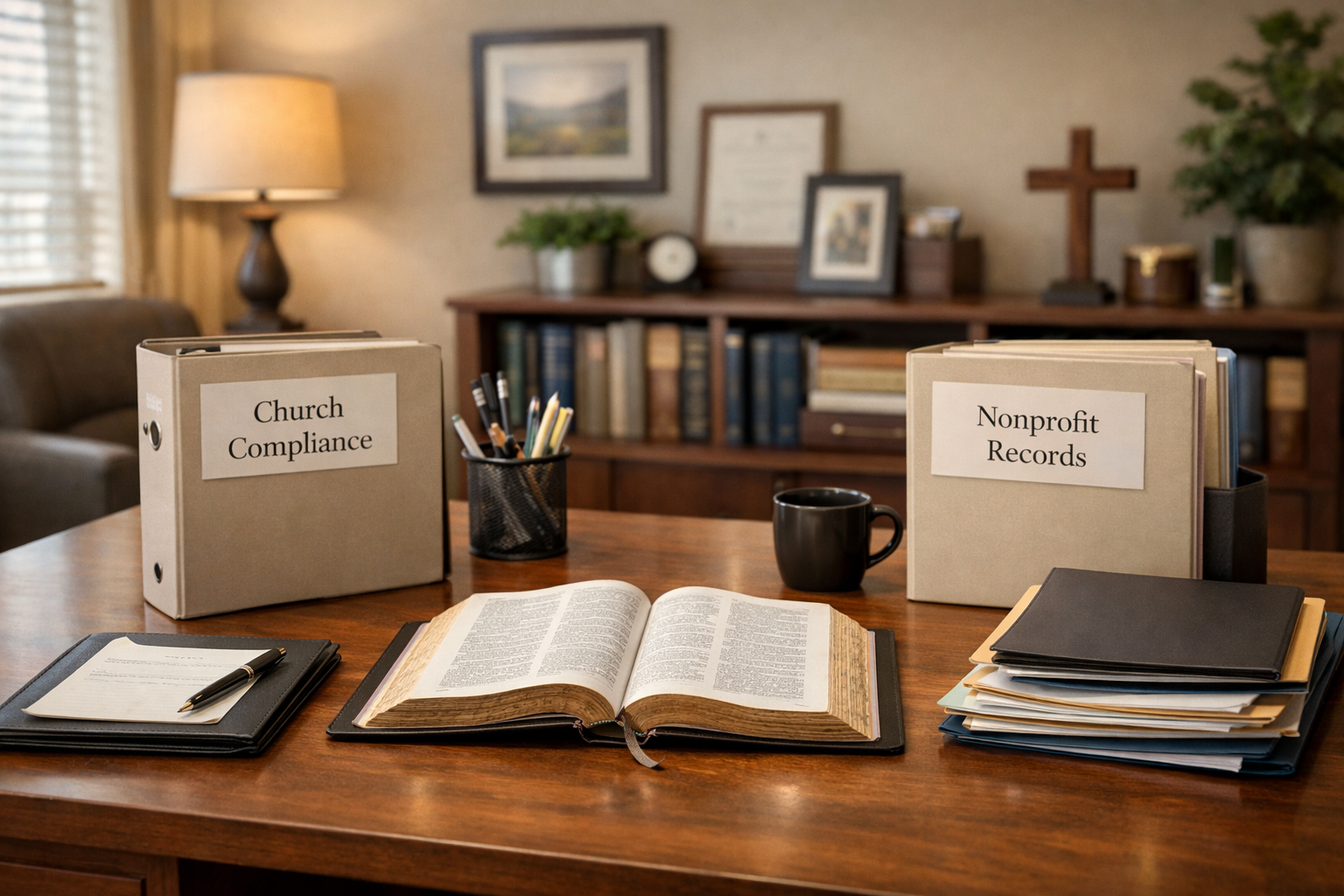
Protecting Your Ministry’s 501(c)(3) Status: Annual Requirements Every Church Should Know

R. Todd Frahm, Partner & DeRicci Keller, Paralegal

January 8, 2026

For pastors and ministry leaders, maintaining your organization’s 501(c)(3) status is far more than a tax matter. It protects your legal standing, preserves donors’ ability to claim tax deductions, and supports trust and accountability with your community. Sadly, many ministries and charities end up losing their exempt status not because they did anything wrong intentionally, but simply because annual requirements were overlooked or misunderstood.

When a nonprofit fails to meet required filings, revocation of its federal tax-exempt status can occur — and restoring that status often takes months of administrative work, corrective filings, and significant resources. The good news is that with clear understanding and systems in place, most compliance failures are avoidable.

1. IRS Annual Filing Requirements Every 501(c)(3) Must Meet

At the federal level, the IRS requires most exempt organizations to file an informational return each year. The type of return depends on the organization’s annual gross receipts:

  • Form 990-N (e-Postcard) — For organizations with gross receipts normally $50,000 or less.
  • Form 990-EZ or Form 990 — For larger nonprofits with receipts above that threshold.
  • Form 990-PF — For private foundations regardless of receipts.

Key Compliance Points:

  • The due date is the 15th day of the fifth month after the end of your fiscal year (e.g., May 15 for organizations on a calendar year).
  • If you fail to file a required Form 990 (any version) for three consecutive years, the IRS automatically revokes your 501(c)(3) status.
  • CRITICAL FOR CHURCHES: Churches and certain religious organizations are generally exempt from filing Forms 990 unless they choose to file. (This exception is narrow and fact-specific; not every ministry is treated as a “church” for IRS purposes.)

Unrelated Business Income (UBI) Tax Requirements

A common compliance oversight involves Unrelated Business Income (UBI). If your ministry or nonprofit generates income from a trade or business activity that is regularly carried on and is not substantially related to its exempt purpose (e.g., operating a bookstore or selling merchandise), you must file:

  • IRS Form 990-T (if gross income from UBI is $1,000 or more).
  • California Form 109 (for state UBI tax).

2. California State Requirements Beyond IRS Filings

For organizations operating in California, compliance includes three separate state filings and registrations beyond federal requirements:

A. Attorney General’s Registry of Charities — Annual Renewal (Form RRF-1)

If your organization solicits contributions, you must register and renew with the California Attorney General’s Registry of Charities and Fundraisers each year. In general, California charitable organizations that hold property for charitable purposes or solicit/receive charitable assets in California must register unless an exemption (such as being a religious nonprofit) applies.

  • File Form RRF-1 and pay the applicable renewal fee.
  • Attach a copy of your most recently filed IRS Form 990, 990-EZ, or 990-PF (excluding Schedule B).
  • These documents are due 4 months and 15 days after the end of your fiscal year.
  • New Requirement for Large Charities: If your organization has annual revenue of $2 million or more, you must submit audited financial statements prepared by an independent CPA. (This requirement generally applies to charitable corporations and unincorporated associations required to register; confirm whether any exemption applies to your entity.)

B. Franchise Tax Board (FTB) — State Income Tax Exemption and Annual Return

In California, having a federal 501(c)(3) letter does not automatically grant the organization state tax exemption. You typically must secure separate state exemption with the Franchise Tax Board (FTB).

  • Most nonprofits must file the California annual information return: Form 199 or Form 199N.
  • The due date generally mirrors the federal due date — by the 15th day of the fifth month after your fiscal year ends.
  • CRITICAL FOR CHURCHES: Churches, interchurch organizations, and religious orders with a valid California exemption letter are generally NOT required to file Form 199/199N. (Confirm status and any applicable exceptions with counsel or a qualified tax professional.)

C. California Secretary of State — Statement of Information (Form SI-100)

Nonprofit corporations in California must file a Statement of Information (Form SI-100):

  • Within 90 days of incorporation, and
  • Every two years thereafter.

This filing keeps your corporate status active and your registration current with the state.

3. What Happens When Compliance Requirements Are Missed

Missing annual filings — federal or state — can have serious and costly consequences:

  • Federal Revocation: Automatic loss of 501(c)(3) status after three consecutive failures to file.
  • California Suspension: Delinquency or suspension with the Attorney General’s registry.
  • Loss of State Exemption: Loss of state tax exemption or suspension of corporate status.
  • Penalties: Penalties or fines for late state returns.

Restoring compliance typically requires corrective filings, payment of fees, and — at the federal level — an application for reinstatement if the IRS has already revoked status. Because reinstatement can be time-consuming and may affect donor deductibility during the gap period, it is best handled promptly and with documentation.

4. Best Practices for Ongoing Compliance

Here are recommended steps to avoid the pain and cost of noncompliance and keep your 501(c)(3) status:

  • Use a Shared Calendar: Track all critical deadlines (IRS, Attorney General, FTB, and Secretary of State).
  • Assign Responsibility: Clearly define who on your leadership team (board treasurer, administrator, or external accountant) is responsible for each filing.
  • Track Financial Thresholds: Monitor financial metrics to ensure you file the correct form (e.g., when gross receipts move above $50,000 or above $2 million).
  • Prepare Early: Gather financials and supporting documents at least 90 days before due dates.
  • Partner with Professionals: Work with professionals experienced in nonprofit tax and state compliance. Also consider adopting written controls (board minutes, conflict-of-interest policy, and record retention) to support good governance and audit readiness.
Give Us a Call

Riverside County: (951) 600-2733

Orange County: (714) 978-2060

Northwest Arkansas: (479) 377-2059

January 8, 2026

Protecting Your Ministry’s 501(c)(3) Status: Annual Requirements Every Church Should Know

Learn the IRS and California requirements churches and nonprofits must meet each year to protect their 501(c)(3) status and avoid costly revocation.

Read full post

November 24, 2025

Protecting Your Congregation: Practical Security & Risk Management for Churches

Learn the legal duties of churches in California regarding security, foreseeability, SB 553 requirements, safety planning, volunteer screening, and insurance protections.

Read full post

October 22, 2025

Understanding the Ministerial Exception: How Courts Protect Churches’ Right to Choose Their Leaders

Every church, synagogue, and ministry shares a common calling: to freely choose who will lead, teach, and represent the faith. The Ministerial Exception is a constitutional doctrine that protects that freedom.

Read full post